
For many brands, Amazon started as a growth channel.
Over time, it quietly became a risk channel.
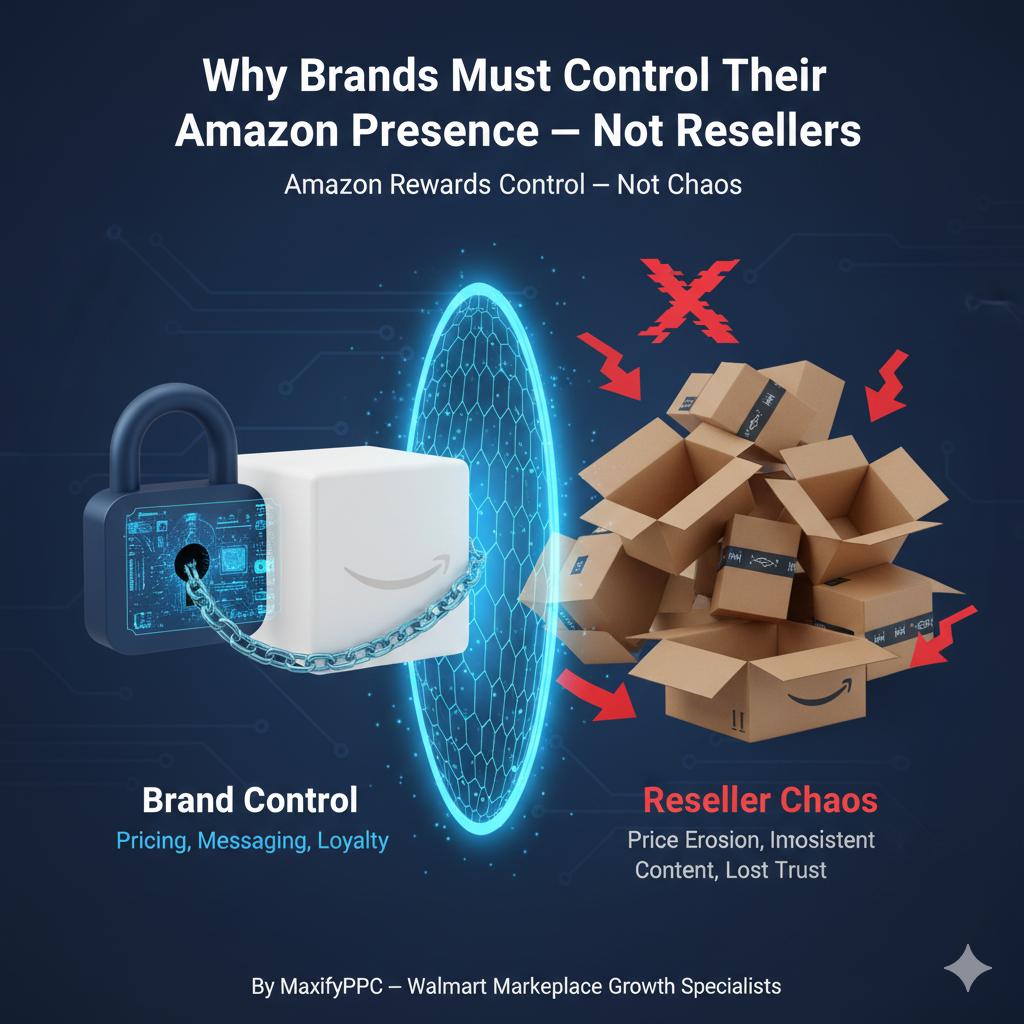
When resellers control your Amazon presence, you don’t just lose margin—you lose authority, consistency, and trust.
And once that control is gone, it’s extremely hard to get back.
Amazon Rewards Control — Not Chaos
Amazon is built to surface the best customer experience, not to protect brand strategy by default.
When multiple resellers compete on the same ASIN:
- Pricing becomes unstable
- Inventory quality varies
- Messaging becomes inconsistent
- Customer experience fragments
From Amazon’s perspective, this is acceptable.
From a brand perspective, it’s damaging.
The Hidden Cost of Letting Resellers Run the Listing
When resellers dominate your listing, brands typically face:
- Price erosion
Resellers race to the bottom, undermining MSRP and retail partners. - Loss of content control
Images, bullets, and titles change—often incorrectly or off-brand. - Customer confusion
Different sellers, different delivery speeds, different return experiences. - Brand dilution
Poor packaging, expired inventory, or diverted goods still carry your name.
Even if the product is authentic, the experience is not controlled.
Why “More Sellers” Is Not a Strategy
Some brands assume multiple sellers mean more exposure.
In reality, it usually means:
- Lower Buy Box stability
- Inconsistent availability
- No single accountable operator
Amazon favors clarity and reliability.
Brands that operate as the primary rights holder and seller consistently outperform fragmented reseller ecosystems.
What Full Brand Control Actually Looks Like
When a brand—not resellers—controls Amazon, the benefits are immediate:
- Stable pricing and margin protection
- Consistent brand messaging across all listings
- Cleaner reviews tied to controlled inventory
- Predictable forecasting and inventory planning
- A single point of accountability for Amazon performance
Most importantly, the brand owns the long-term customer relationship, not whoever wins the Buy Box that day.
Control Is the Difference Between a Channel and a Liability
Amazon can either be:
- A disciplined, scalable sales channel
- Or an unmanaged marketplace that slowly erodes brand value
The difference is control.
Brands that take ownership—through proper structure, protection tools, and controlled distribution—don’t fight Amazon.
They work with it, on their terms.
Final Thought
If resellers are setting your price, shaping your listing, and representing your brand—you’re not selling on Amazon.
You’re being sold through.
And that distinction matters.