
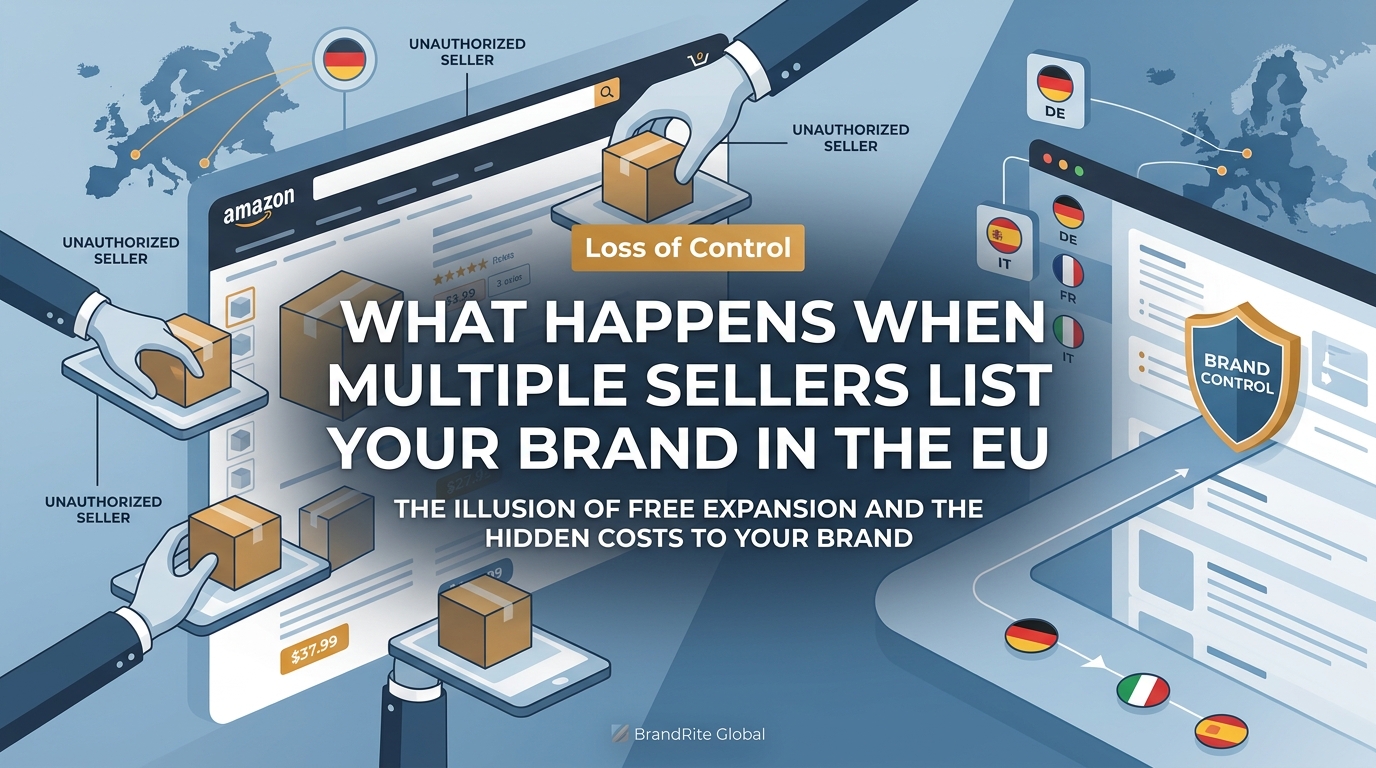
Many U.S. brands assume that when they expand into Amazon Europe, they’ll control how their products are sold.
In reality, that’s often not what happens.
Before a brand officially enters the EU, it’s common for multiple third-party sellers to already be listing and selling the same products across European marketplaces.
At first, this may look like early demand.
But over time, it creates a much bigger issue:
Loss of control.
How It Starts
Most of the time, it begins quietly.
A distributor, reseller, or international buyer sources your product in the U.S. and lists it on Amazon EU marketplaces.
Then another seller follows.
And another.
Before long, your brand is present in Europe — but not in a structured way.
The Illusion of “Free Expansion”
At a glance, this can seem positive:
- Your product is already selling internationally
- There’s visible demand
- You didn’t invest anything to enter the market
But this “organic expansion” comes with hidden costs.
What Actually Happens Over Time
1️⃣ Pricing Erodes
With multiple sellers competing on the same listing:
- Prices begin to drop
- Margins get compressed
- Discounting becomes the norm
Even if your brand enters later, it’s forced to compete against already lowered price expectations.
2️⃣ Listing Control Disappears
Without structured control:
- Product titles and bullet points get altered
- Images may be changed or downgraded
- Translations are often poor or incorrect
This directly impacts conversion and brand perception.
3️⃣ Compliance Risks Increase
This is one of the most overlooked issues.
Third-party sellers:
- Don’t manage EU compliance properly
- May use incorrect labeling
- Don’t appoint a Responsible Person
If your brand name is on the product, you are still exposed to regulatory risk—even if you didn’t list it.
4️⃣ Inventory and Availability Become Unpredictable
Unauthorized sellers operate without coordination.
This leads to:
- Frequent stockouts
- Inconsistent supply
- Poor customer experience
Over time, this affects listing performance and ranking.
5️⃣ Brand Perception Weakens
Customers don’t differentiate between sellers.
They see:
- Inconsistent pricing
- Mixed-quality listings
- Unclear brand messaging
The result is a diluted brand presence in the market.
Why Fixing It Later Is Harder
Once multiple sellers establish themselves:
- They gain Buy Box history
- They build reviews under the listing
- They anchor pricing expectations
Cleaning up becomes significantly more difficult than starting with control from day one.
The Strategic Reality
Amazon EU rewards structured operators.
When brands don’t actively control their presence:
- The market fills the gap
- Third parties define the brand experience
- Long-term positioning gets compromised
This is not just an operational issue.
It’s a strategic one.
How BrandRite Global Approaches This
At BrandRite Global, we focus on controlled market entry.
That means:
- Establishing a single, structured presence
- Securing listing authority
- Aligning pricing across marketplaces
- Managing compliance properly
- Actively monitoring and enforcing against unauthorized sellers
Because in Europe, control is not optional — it’s foundational.
The Takeaway
Expansion without control is not expansion.
It’s exposure.
The brands that succeed in Europe are not the ones that get there first —
they are the ones that get there with structure.