
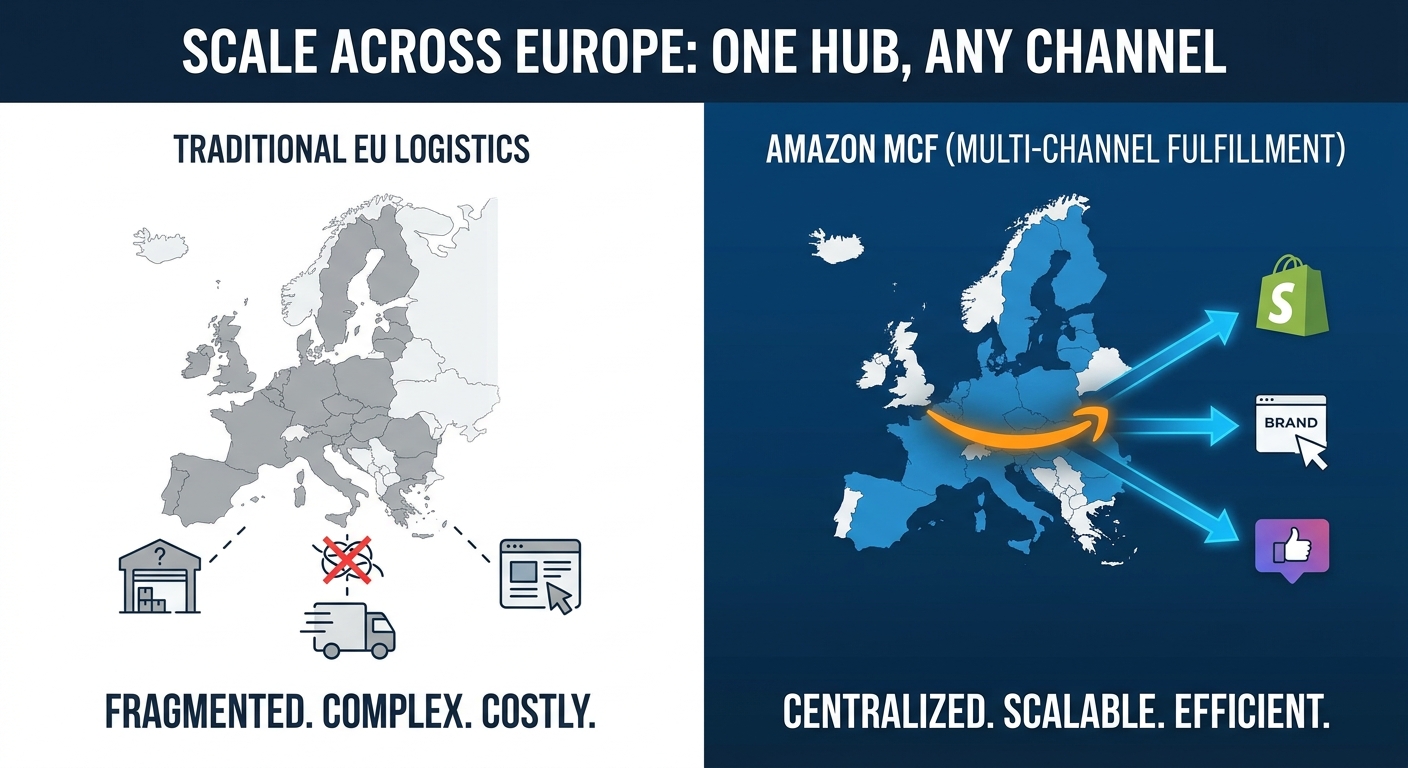
For many U.S. brands, expanding across Europe feels operationally heavy.
The assumption is usually the same:
If you want to sell on multiple ecommerce channels in the EU, you need:
- Separate warehouses
- Additional fulfillment partners
- Country-by-country logistics operations
- Complex inventory management systems
But that is no longer necessarily the case.
With Amazon Multi-Channel Fulfillment (MCF), brands can use Amazon’s fulfillment infrastructure to support orders beyond Amazon itself — including their own ecommerce websites and other online sales channels across Europe.
For brands expanding internationally, this changes the operational equation significantly.
What Amazon MCF Actually Does
Amazon Multi-Channel Fulfillment allows inventory stored in Amazon fulfillment centers to fulfill orders from external channels.
This means inventory inside Amazon’s network can also support:
- Shopify stores
- Brand websites
- Other ecommerce marketplaces
- Social commerce channels
Instead of building separate fulfillment operations, brands can leverage infrastructure that already exists.
Why This Matters More in Europe
Europe introduces operational complexity very quickly.
Selling across multiple countries traditionally requires:
- Regional warehousing decisions
- Cross-border shipping coordination
- Local delivery expectations
- Multi-country inventory planning
For many brands, logistics becomes the bottleneck before demand does.
MCF reduces that friction.
By centralizing inventory within Amazon’s network, brands can:
- Reach multiple EU markets faster
- Reduce operational overhead
- Avoid building separate fulfillment layers early on
This allows expansion to happen with significantly less infrastructure.
The Strategic Advantage of Centralized Fulfillment
One of the biggest challenges in international expansion is fragmentation.
Different systems.
Different inventory pools.
Different operational workflows.
MCF helps simplify this.
Instead of managing:
- Amazon inventory separately
- Shopify inventory separately
- EU marketplace fulfillment separately
Brands can operate from a more unified fulfillment structure.
This improves:
- Inventory visibility
- Operational efficiency
- Forecasting accuracy
- Scalability across channels
Faster Expansion Without Operational Bloat
Many brands delay EU expansion because they believe scaling internationally requires a major operational buildout.
But in many cases, the opposite is now possible.
With the right structure:
- One inventory pool can support multiple channels
- Fulfillment can remain centralized
- Additional warehousing can be delayed until justified by volume
This creates a leaner path into European ecommerce.
Where Brands Need to Be Careful
MCF is powerful — but it still needs to be structured correctly.
Brands must consider:
- VAT implications across countries
- Delivery expectations by marketplace
- Inventory positioning strategy
- Channel-specific customer experience
MCF simplifies logistics operations, but it does not remove the need for operational planning.
How BrandRite Global Approaches MCF in Europe
At BrandRite Global, we view Amazon MCF as part of a broader EU scaling strategy.
We help brands:
- Structure fulfillment efficiently from the beginning
- Align inventory with multi-channel growth
- Reduce unnecessary operational complexity
- Expand into Europe without prematurely building large logistics systems
The goal is not just to sell in Europe.
It’s to scale efficiently while maintaining operational clarity.
The Takeaway
European expansion no longer requires building a separate logistics ecosystem from day one.
With Amazon MCF, brands can leverage infrastructure that already exists to support growth across multiple ecommerce channels.
When implemented correctly, this creates:
- Faster market entry
- Lower operational overhead
- More scalable multi-channel expansion
In today’s environment, operational simplicity is a competitive advantage.