
When brands expand into Amazon UK and Europe, most of the focus goes to the obvious:
Listings.
Compliance.
Logistics.
Advertising.
But there’s a less visible layer inside Seller Central that quietly drives performance across Europe:
How your fulfillment structure is configured.
Most brands don’t actively manage this.
They rely on default settings — and those defaults often don’t align with a scaling strategy.
The Setting That Drives More Than You Think
Inside Seller Central, your cross-border and fulfillment configuration determines:
- Where your inventory is stored
- Which countries your products are sold in
- How orders are fulfilled
- What delivery promise the customer sees
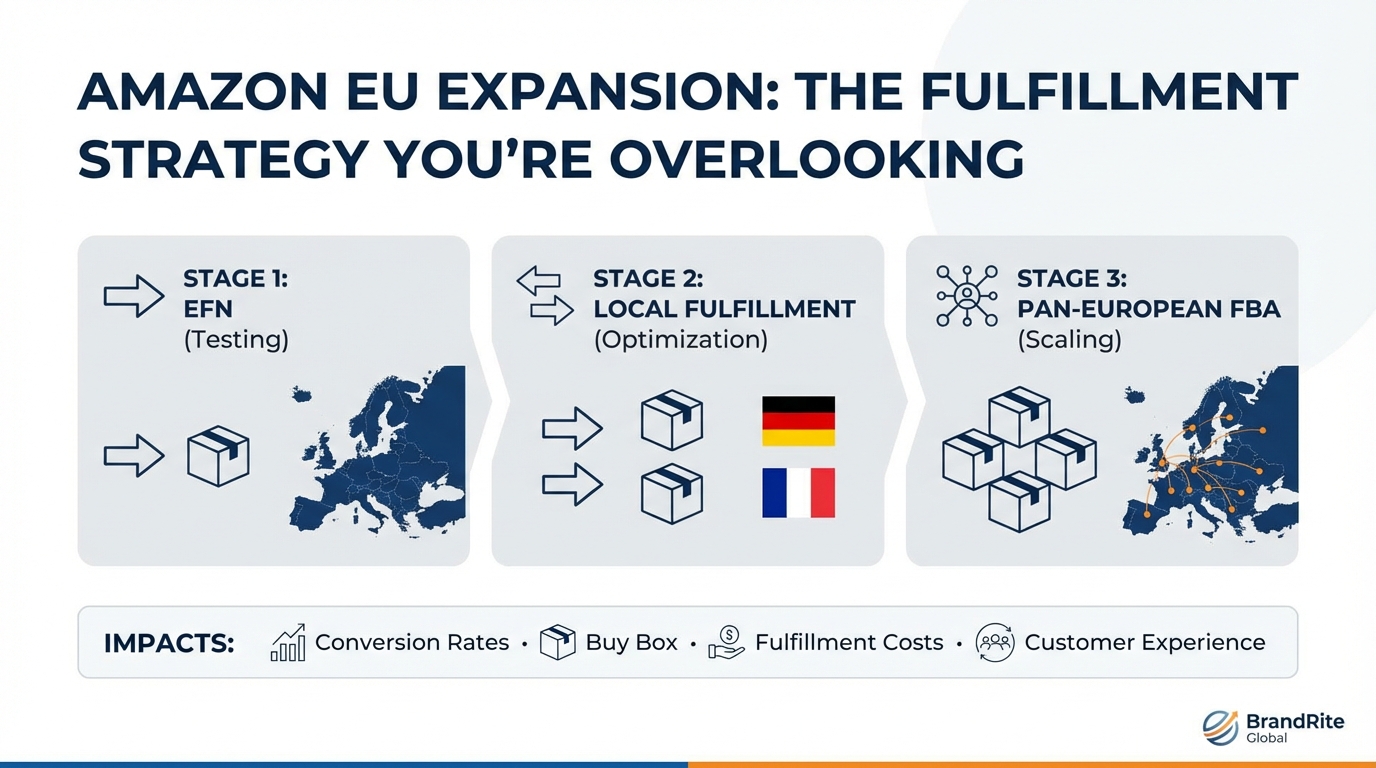
These factors directly influence:
- Conversion rates
- Buy Box competitiveness
- Fulfillment costs
- Customer experience
Amazon executes based on your setup — not your intent.
The Three Stages of EU Fulfillment (What Most Brands Miss)
EU fulfillment isn’t one setup.
It evolves in stages.
1️⃣ EFN — The Starting Poin
The European Fulfillment Network (EFN) allows you to store inventory in one country (typically Germany) and ship orders across other EU marketplaces.
This is useful for:
- Testing demand
- Minimizing upfront complexity
- Entering multiple countries quickly
But EFN comes with tradeoffs:
- Longer delivery times
- Higher cross-border fees
- Lower Buy Box competitiveness
- Reduced conversion rates in some markets
EFN is a testing layer, not a long-term solution.
2️⃣ Local Fulfillment — The Optimization Layer
As demand becomes clearer, brands often begin storing inventory in additional countries.
This improves:
- Delivery speed
- Customer experience
- Marketplace competitiveness
However, it also introduces:
- VAT obligations in each country
- More complex inventory planning
- Operational overhead
At this stage, structure becomes critical.
3️⃣ Pan-European FBA — The Scaling Layer
Amazon Pan-European FBA (Pan-EU) allows Amazon to distribute your inventory across multiple EU countries and fulfill orders locally within each market.
This unlocks:
- Fast, local delivery across Europe
- Lower fulfillment costs
- Stronger Buy Box positioning
- Higher conversion rates
But Pan-EU is not just a switch.
It requires:
- VAT registration across multiple countries
- Clean compliance setup
- Strong inventory planning
- Structured operational control
Pan-EU is a scaling decision, not a starting configuration.
Where Brands Go Wrong
Most issues don’t come from the tools — they come from the sequence.
Common mistakes include:
- Staying on EFN too long and losing competitiveness
- Activating Pan-EU too early without infrastructure
- Letting all SKUs default into cross-border availability
- Misaligning fulfillment with pricing and margins
These decisions are often made passively — but they have active consequences.
The Hidden Impact on Pricing and Buy Box
Fulfillment structure directly affects your unit economics.
For example:
- A product fulfilled locally in France may win the Buy Box
- The same product shipped cross-border from Germany may not
If fulfillment isn’t aligned with pricing strategy:
- Margins get squeezed
- Conversion drops
- Performance varies across markets
Most brands don’t realize this until they start scaling.
Fulfillment Is a Strategy — Not a Setting
Strong EU operators don’t rely on default configurations.
They:
- Control where inventory is positioned
- Decide when to expand into additional countries
- Use EFN for testing, not scaling
- Transition into Pan-EU at the right time
- Align fulfillment with advertising and pricing
This creates consistency across markets
How BrandRite Global Approaches This
At BrandRite Global, fulfillment is part of the expansion strategy — not a backend decision.
We:
- Start with controlled market entry
- Validate demand before increasing complexity
- Structure VAT and compliance before scaling
- Transition into Pan-EU when the foundation is ready
Because in Europe, how you operate matters as much as where you sell.
The Takeaway
EU expansion isn’t just about being present in multiple marketplaces.
It’s about how your operation is structured behind the scenes.
EFN, local fulfillment, and Pan-EU are not competing options.
They are stages.
And when used in the right sequence, they turn complexity into leverage.