
As brands grow on Amazon Amazon, most pricing decisions are focused on one thing:
The retail customer.
But one of the most overlooked growth opportunities on Amazon is the business customer.
Amazon Business continues to grow across the U.S., UK, and Europe, and many brands are missing the opportunity because their pricing structure is built only for standard consumer purchasing behavior.
This is where business pricing and quantity discount strategy become important.
What Amazon Business Pricing Actually Is
Amazon allows brands to create special pricing structures specifically for business buyers.
This includes:
- Business-only pricing
- Tiered quantity discounts
- Bulk purchase incentives
Instead of selling only one unit at a time, brands can encourage:
- Larger order sizes
- Repeat purchasing behavior
- Multi-unit transactions
For many categories, this can significantly increase order efficiency.
Why Quantity Discounts Increase Demand
Business customers think differently than regular retail customers.
They are often purchasing for:
- Offices
- Facilities
- Teams
- Professional use
- Resale or operational needs
When business buyers see structured quantity discounts, it creates purchasing confidence.
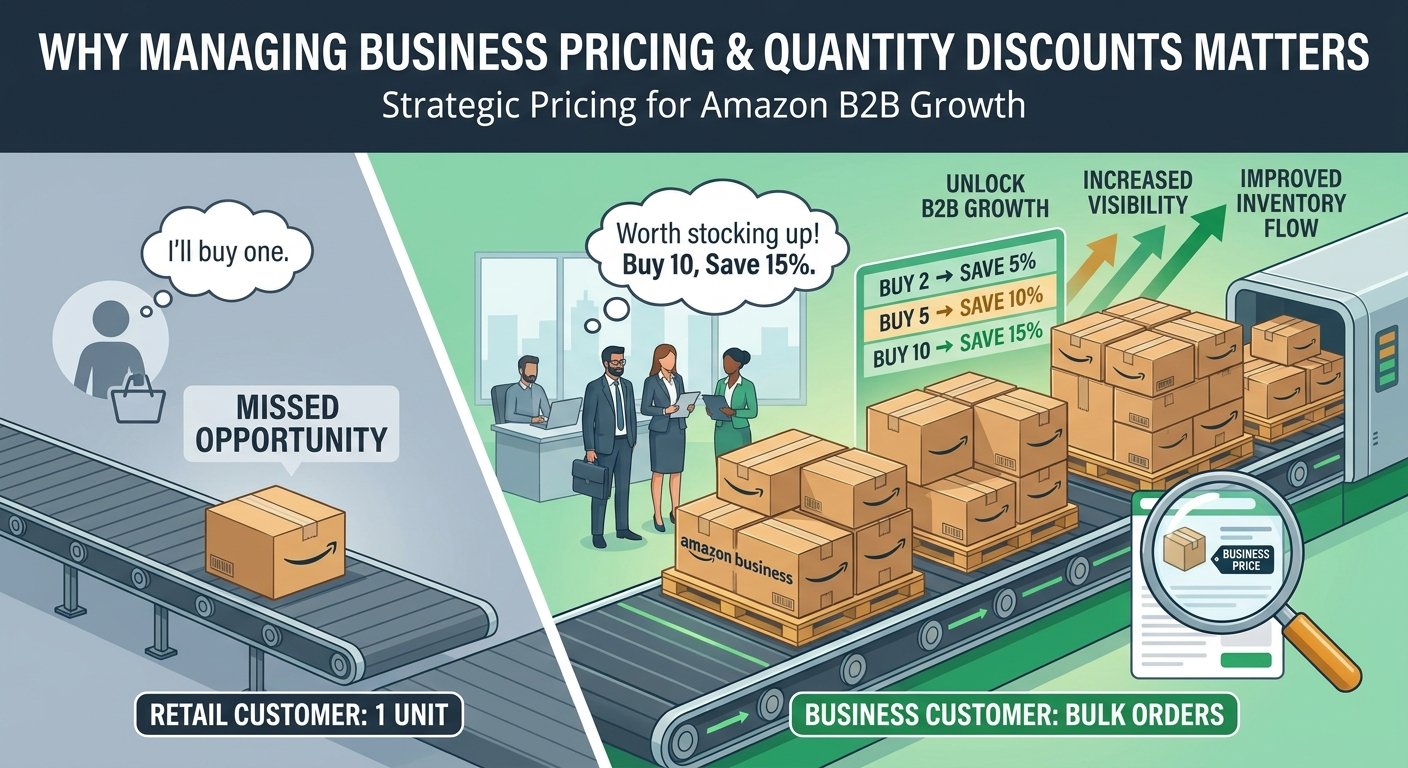
For example:
- Buy 2 → save 5%
- Buy 5 → save 10%
- Buy 10 → save 15%
This changes the customer mindset from:
“I’ll buy one.”
to:
“This is worth stocking up on.”
The Hidden Advantage: Increased Visibility
Many brands don’t realize that Amazon Business pricing can also improve product attractiveness within Amazon’s ecosystem.
Products with:
- Strong business pricing
- Clear quantity incentives
- Competitive bulk value
often perform better with:
- Higher-volume buyers
- Procurement-focused customers
- Organizations purchasing repeatedly
In some categories, business buyers represent a significant portion of total marketplace demand.
Why Most Brands Manage It Poorly
A common mistake is offering discounts without strategy.
This creates problems such as:
- Margin compression
- Uncontrolled discounting
- Weak pricing structure
- Marketplace inconsistency
Business pricing should not simply be “lower pricing.”
It should be structured around:
- Margin protection
- Inventory movement
- Customer lifetime value
- Competitive positioning
The goal is to increase purchasing volume without damaging long-term pricing stability.
Quantity Discounts Can Improve Inventory Flow
Another major advantage of business pricing is operational.
Larger orders help:
- Move inventory more efficiently
- Reduce long-term storage pressure
- Improve replenishment predictability
- Increase revenue per transaction
For brands scaling internationally, this becomes especially valuable.
The International Opportunity
In Amazon UK and EU marketplaces, many business buyers:
- Prefer bulk purchasing
- Reorder consistently
- Value operational reliability over small price differences
Brands that structure business pricing correctly can create:
- More stable purchasing patterns
- Stronger account-level relationships
- Better long-term marketplace positioning
This is especially powerful in categories such as:
- Beauty and personal care
- Wellness products
- Household consumables
- Office-related products
- Accessories and replenishable items
How BrandRite Global Approaches Business Pricing
At BrandRite Global, pricing strategy is treated as part of marketplace positioning — not just discount management.
We evaluate:
- Marketplace competition
- Bulk purchasing behavior
- Margin structure
- Inventory efficiency
- Long-term pricing stability
The objective is not simply to lower prices.
It is to create structured incentives that:
- Increase purchasing demand
- Improve order size
- Strengthen marketplace competitiveness
- Support scalable growth across Amazon UK & EU
The Takeaway
Business pricing and quantity discounts are not just promotional tools.
When structured correctly, they become growth tools.
They help brands:
- Increase order volume
- Improve operational efficiency
- Expand exposure to business buyers
- Create stronger purchasing behavior across marketplaces
And in increasingly competitive ecommerce environments, smarter pricing structure often creates more sustainable growth than aggressive discounting alone.