
Many brands entering Amazon Europe make a costly assumption:
“If our price works in one country, it should work in all of them.”
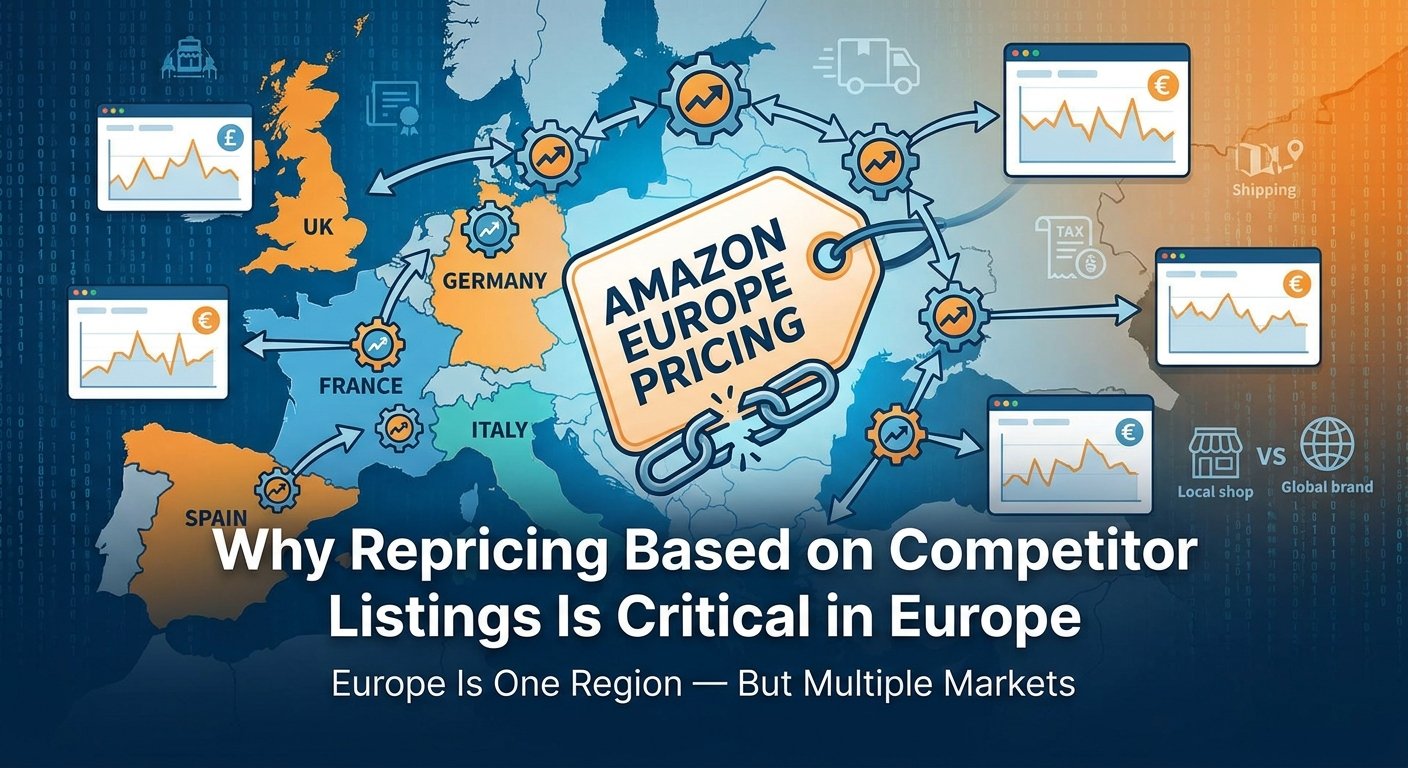
In reality, Europe doesn’t operate as a single marketplace.
Each country has different competitors, different customer expectations, different shipping dynamics, different tax structures, and different levels of competition.
As a result, a pricing strategy that performs well in Germany may underperform in France, Spain, Italy, the Netherlands, or Sweden.
This is why successful brands don’t manage pricing at the EU level. They manage pricing at the country level.
Europe Is One Region — But Multiple Markets
A common mistake is treating Europe as a single customer base.
While the marketplaces are connected, buying behavior varies significantly between countries.
For example, a product may face twenty competitors in Germany, only a handful in Sweden, and an entirely different competitive landscape in Italy.
If pricing remains identical across all countries, brands often leave revenue on the table or become uncompetitive without realizing it.
The strongest brands recognize that each marketplace should be evaluated independently.
Your Real Competitor Changes By Country
Many brands know exactly who their competitors are in the United States.
What surprises them is that their competitive set often changes dramatically across Europe.
In Germany, you may compete against established local brands with years of marketplace history.
In France, customers may be willing to pay more for premium positioning.
In Spain, lower-priced alternatives may dominate the category.
In the Netherlands, a completely different set of sellers may control the market.
This means pricing decisions should not be based solely on internal costs. They should reflect the actual competitive environment within each marketplace.
Why Static Pricing Creates Problems
When pricing is set and forgotten, one of two things usually happens.
If prices are too high compared to competitors, conversion rates decline, Buy Box performance weakens, advertising becomes less efficient, and growth slows.
If prices are too low, margins shrink unnecessarily and profitability suffers.
In both cases, the issue isn’t the product.
It’s the pricing strategy.
Many brands unknowingly operate with the same price across multiple countries even though the competitive conditions are completely different.
Repricing Is Not About Being the Cheapest
One of the biggest misconceptions about repricing is that the goal is to have the lowest price.
That is rarely the best strategy.
The objective is to position your product correctly relative to the market.
Sometimes that means lowering price.
Sometimes that means maintaining price.
And sometimes it means increasing price because the market supports it.
Effective repricing focuses on maximizing profit and sales simultaneously.
The goal is to win customers, not race competitors to the bottom.
The Impact on Buy Box Performance
Pricing plays a significant role in Buy Box ownership.
When multiple sellers offer similar products, Amazon evaluates various factors including pricing, fulfillment, seller performance, and delivery speed.
Even small differences in pricing can influence Buy Box share.
A brand that continuously monitors competitors can make adjustments that improve visibility without unnecessarily sacrificing margin.
Over time, these improvements compound into stronger sales performance.
Why Country-Level Repricing Creates an Advantage
Brands that actively monitor pricing by country gain a significant advantage over those that use a blanket EU pricing strategy.
They can:
- Respond to local competition
- Protect margins where competition is weaker
- Improve conversion rates
- Increase Buy Box ownership
- Adjust to changing market conditions
Most importantly, they can make decisions based on real marketplace data rather than assumptions.
The Role of Automation and Daily Monitoring
Competition changes constantly.
New sellers enter the market.
Inventory levels fluctuate.
Promotions begin and end.
This is why repricing should not be viewed as a one-time task.
The most successful operators continuously monitor marketplace conditions and adjust accordingly.
Small adjustments made consistently often outperform major pricing changes made occasionally.
How BrandRite Global Approaches Repricing
At BrandRite Global, pricing is treated as a strategic growth lever rather than an administrative task.
We analyze each marketplace individually, monitoring:
- Competitor pricing
- Buy Box dynamics
- Inventory levels
- Demand trends
- Profitability targets
This allows us to make informed decisions that balance growth with margin protection.
Because successful pricing isn’t about reacting.
It’s about staying one step ahead of the market.
The Takeaway
Europe may be connected through Amazon’s infrastructure, but it remains a collection of individual marketplaces.
Brands that treat Europe as one market often miss opportunities and lose competitiveness.
Brands that understand each country’s competitive landscape gain a significant advantage.
The strongest pricing strategy is not the lowest price.
It’s the right price for the right marketplace at the right time.
And in Amazon Europe, that difference can have a major impact on both growth and profitability.